How to handle a one-star review and turn it into a success story
What happens when you actually pick up the phone and call someone who left your business a negative review? We talked to Dayna Edens, Public Relations Manager at ConsumerAffairs, who recently did exactly that.


I called an unhappy customer to understand why
I’m Dayna, PR Manager at ConsumerAffairs, and part of my job is tracking what people say about our brand, especially when it’s not positive. Aspect by ConsumerAffairs is built on that same idea, listening to customer feedback and acting on it, and we can help your business turn negative reviews into positive ones.

Every business gets one star reviews sooner or later, but with the right approach, you can easily turn 1-star customer reviews into success stories, often without offering a gift card or any kind of future discount.
I recently called a consumer who left two 1-star reviews about the same issue. By the end of our conversation, he not only had a totally different perspective, but he also deleted one of those reviews and updated the other to five stars without me asking him.
Calling one-star reviewers won’t always end like this, but understanding what happened during this conversation can help you get a similar outcome for your brand.
1Understand the stakes
When I saw two 1-star reviews from the same consumer, my first thought was, “Okay, so maybe he’s not our biggest fan.”
Address this single negative review, and you could avoid 10 others.
However, our brand’s reputation was at stake, and I approached the call not with the goal of getting the person to change their reviews, but instead to gain a better understanding of where we went wrong.
A 1-star review is telling you something went wrong from the customer’s perspective, and if you can figure out what the problem was, you can, at the very least, prevent it from happening with another customer. Address this single negative review, and you could avoid 10 others. That’s really what’s at stake, and it’s why reaching out to listen is so important.
2Reach out directly when you can
When a customer is less than pleased with a brand, they’re almost never going to take kindly to an automated email asking them to explain what made them so unhappy.
“Yeah, I’m sitting down, I guess.”
Not exactly a warm welcome. But that’s okay.But a phone call from a real human who’s actually trying to get to the root of the issue is an entirely different story.
In my case, the review was posted about ConsumerAffairs on Trustpilot, so I used the platform’s process to request the reviewer’s contact information. He voluntarily provided his phone number, so I called.
When he answered, I introduced myself and asked if he had a few minutes to talk about his review. He said, “Yeah, I’m sitting down, I guess.” Not exactly a warm welcome. But that’s okay.
I couldn’t control how he felt about my company when he answered the phone, but I could control how I approached the conversation: a real person asking you what happened and how they could prevent the issue from recurring instantly puts customers in a different mindset.
3Let them get it all out
If someone has taken the time to leave a 1-star review, there’s a good chance they’re frustrated.
“Tell me why you wrote this review. Walk me through the steps that got you here.”
Then stop talking and listen.And when someone’s frustrated, letting them talk is almost always the best way to start a conversation.
Your first instinct might be to start defending your brand or explaining why the customer is wrong. Don’t. Instead, ask an open-ended question. “Tell me why you wrote this review. Walk me through the steps that got you here.” Then stop talking and listen.
Acknowledge what you’re hearing so they know you’re there, but don’t cut them off every time they say something you disagree with. Let them get everything off their chest.
While this consumer was talking, I was listening out for the specific concerns behind his review. I knew that if I could identify and understand those concerns, I could actually address them.
It turns out there’s a whole chapter in Dale Carnegie’s How to Win Friends and Influence People about doing something similar. It really works, and not just for me.
4Answer with facts, not arguments
At this point, your goal should be to explain rather than argue. Stick with the facts.
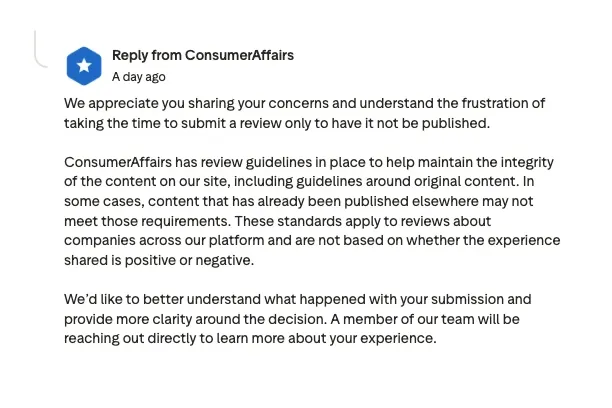
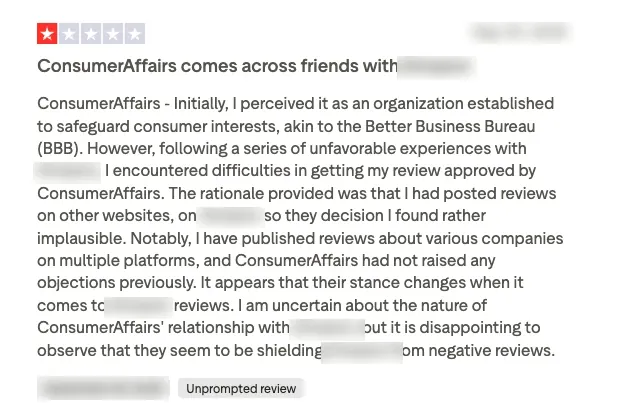
This customer’s first concern was that ConsumerAffairs wouldn’t let people post negative reviews.
He told me he’d previously submitted a negative review that wasn’t published on ConsumerAffairs. Bingo. I found the review he was referring to and saw that because the same review had already appeared on another review site, it didn’t meet our guidelines and wasn’t published.
Oh, you have human moderators?
So I explained that every review submitted to ConsumerAffairs goes to our moderation team. It’s not AI scanning the reviews but an actual human making sure it passes our review guideline checklist. Duplicate reviews are a sign of spam responses, which are against our guidelines.
And once I explained that, he said: “Oh, you have human moderators?” I could actually hear his mood change in response to a reasonable explanation as to why his review didn’t show up and that we didn’t use some automated process to keep out negative reviews.
His next concern was that ConsumerAffairs only publishes positive reviews for big brands. I pulled up the profile of a large retailer and showed him page after page of 1-star reviews. He could see for himself that wasn’t true.
5Find out what’s really driving the review
Once we’d worked through his concerns, I asked how else he’d used ConsumerAffairs.
If I can delete it, I’ll delete it. If not, I’ll change it to five stars and write why.
It turned out he reads our recall news and scam alerts and actually finds them helpful. That changed how I viewed his original reviews, too: he was only frustrated because he didn’t understand why one of his reviews hadn’t been published, and that frustration had shaped how he viewed the rest of our business.
I asked one more question to solidify what had already happened on the call: “Has your opinion of ConsumerAffairs changed since we started talking?” He said, “Well, I guess so.”
Now it was his idea that his opinion had changed. I asked whether he had any other questions about our brand, our moderation process or our review guidelines and whether our conversation had cleared up the concerns behind his reviews and whether he’d want to update them.
Resolving a customer’s complaint shouldn’t come with conditions, and offering something in exchange for a better review is disingenuous.
I did not suggest a rating or tell him what to write. And I didn’t offer him anything in exchange for changing or removing his review: resolving a customer’s complaint shouldn’t come with conditions, and offering something in exchange for a better review is disingenuous.
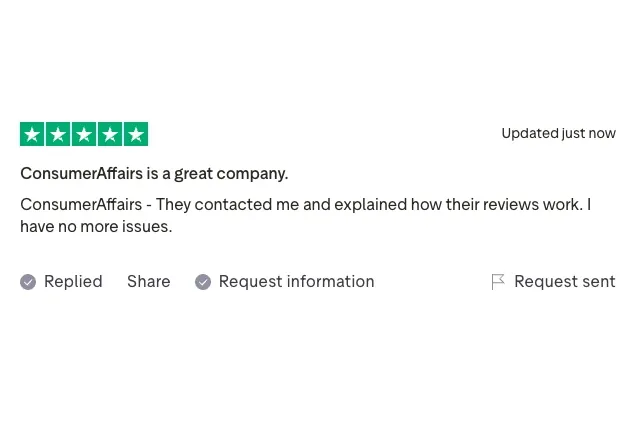
Without a promise of anything in return, he said: “If I can delete it, I’ll delete it. If not, I’ll change it to five stars and write why.”
That was his decision. And if he’d said, “No, I’m keeping both reviews exactly as they are,” that would’ve been his decision, too. That will happen sometimes, and you have to accept it.
6The review isn’t the goal
This is probably the biggest takeaway from the whole experience: an updated review isn’t the goal.
Don’t call a 1-star reviewer because you want five stars.
In the grand scheme of things, a single negative review isn’t going to mean much if the rest of your reviews are mostly positive. The real goal is to ensure the rest of your reviews are positive by learning from the negative ones.
Don’t call a 1-star reviewer because you want five stars. Instead, call because there’s a person behind that review who had an experience with your business that left them frustrated enough to tell other people about it.
Figure out what happened, correct misunderstandings when you can, and own legitimate problems when you find them. After you hang up the call, fix what you can so that future customers don’t run into the same issues.
Sometimes a real conversation with a 1-star review can change how someone feels about your company. Sometimes it won’t, but even when it doesn’t it gives you some of the most valuable feedback you can get as a business.
In my case, it happened to end with a reviewer deleting one 1-star review and changing the other to five stars. That’s what we call a spotlight review. I didn’t have some magic script going into the call to get a better review. I just tried to talk to him like a person and understand where he was coming from.
If they don’t answer, leave a voicemail and follow up by email
Of course, none of this can take place if your reviewer doesn’t answer.
Hi [First Name],
My name is Dayna Edens, and I’m the PR manager at ConsumerAffairs. If you’re wondering where you’ve heard my name before, it’s from the voicemail I just left you.
I came across your review of ConsumerAffairs on Trustpilot, and while I left you a public response there, I also wanted to follow up with you personally. I’d like to hear more about your experience and what happened so we can better understand the issue and see what we can do to make things right.
I’m happy to chat over email, or you can give me a call back at the number in your missed calls: [your number]. That’s my cell, so feel free to reach out directly.
Talk soon,
Dayna
But if they don’t, don’t just figure a single call is good enough. Leave a voicemail and let them know you’ll follow up over email in case that’s an easier way to communicate, and then send an email.
Here’s the email I would have sent if I hadn’t gotten this customer on the phone.
Remember, you can’t control whether someone changes their review. But you can control how you respond when a customer tells you something went wrong.
Talk to an Aspect expert
Talk to an Aspect expert to get more information about using this service to improve your business.